

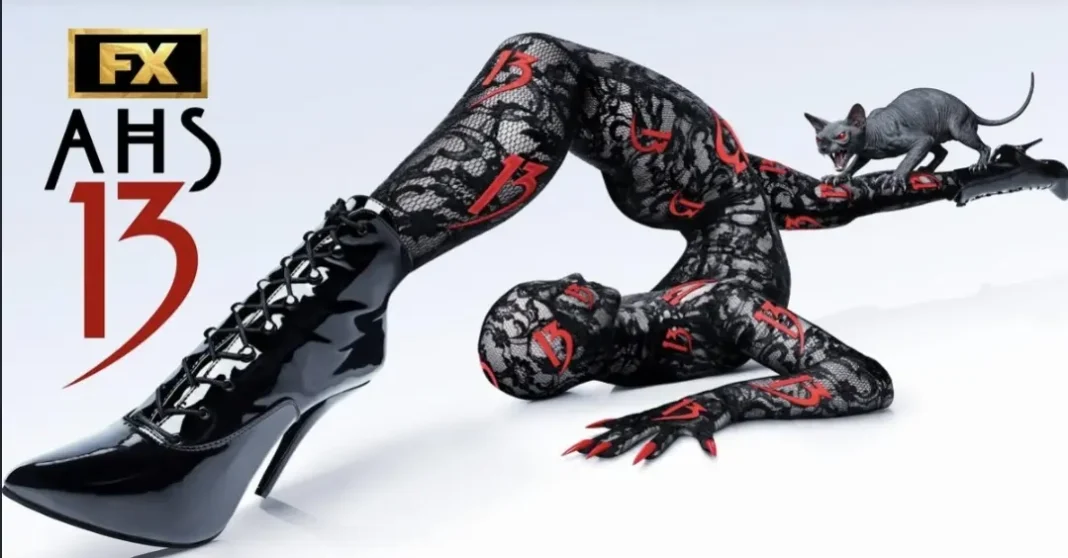
The following recap contains spoilers for American Horror Story: 13 Episode 4 (“Is That All There Is?”), Episode 5 (“Date Night”), and Episode 6 (“The Return of Devil’s Night”)
The season opens its second act with Jessica Lange, in her Elsa Mars skin from Freak Show, performing “Is That All There Is?” And reader, I have rarely watched a show hand a critic her thesis so generously. Peggy Lee’s world-weary shrug of a song—if that’s all there is, then let’s keep dancing—is not just a cold open. It is, whether the show knows it or not, the only honest question American Horror Story: 13 asks across its middle three episodes, and the answer it keeps arriving at is: yes. This is all there is. A pit of recycled characters, a fistful of monologues, and a grieving man reheating a dead woman’s frozen meals.
Let me back up, because “backing up to explain” is, fittingly, this batch’s entire mode of storytelling.

We open on a dream. Ben—the uncompelling lead I spent the premiere describing as the void at the center of the show—floats through red light and Ryan Murphy set-piece vibes into a nightmare where famous women are tossed into a hell-pit as sacrifices. Margaret Thatcher goes in. The Black Dahlia goes in. Sally from Hotel goes in. When the show runs out of women to throw, Sarah Paulson says “Hail Satan” and throws herself in, which is the funniest and, I think, the most honest thing that happens in three hours of television. The pit is literally a clip show of Paulson’s own back catalogue, and the season is so stuffed with her that it runs out of bodies and has to feed her to herself. If you wanted a single image for what “the Avengers of AHS” cashes out to in practice, it is Sarah Paulson sacrificing one of her characters to make room for another one of her characters.
Then Ben wakes up, and John Waters—Mr. Phibes, the physician, an original member of the Church of Satan who was in the room the night Anton LaVey shaved his head—stands over him and explains the entire mythology. This is the first of the batch’s three major exposition dumps, and I log them the way Ben’s show logs the number thirteen: obsessively, because there is nothing else to count. Phibes delivers the doctrine of thirteen—Judas the thirteenth guest at the Last Supper, twelve the perfect number disrupted into chaos—and then, almost as an afterthought, that the Dark Lord let his son drink from the chalice. His son. Ben, the hospice nurse sent to care for the dying old man who is becoming Satan, is Satan’s son. The nightmare was not a nightmare. It was the ritual, happening, disguised as a dream so the show could stage a plot beat without admitting it had one.

This is the engine of the whole batch, and it is worth naming clearly: the show cannot deliver information except by having a character stand still and recite it. Phibes briefs us on the mythology. Phibes briefs us on the parentage.
Later, a plane-crash survivor briefs us on the plane crash. Three times in roughly an episode and a half, the season reaches a moment that could have been a scene—tense, gradual, lived by the viewer in real time—and instead becomes a podium. American Horror Story: 13 does not dramatize. It briefs. The stars perform and exactly one man explains, and the two almost never happen in the same room.
Which is a shame, because the performing half of the equation is where the real waste is. Jamie Brewer returns as Addie. Evan Peters returns as Tate, in the Rubber Man suit the whole time, which I will permit on purely aesthetic grounds. And then the show gives them nothing to do. I counted. Addie gets roughly four lines, two of which are “drink it.” Tate gets one line this episode. These are not deep cuts; these are two of the most beloved figures in the entire franchise, resurrected and handed the dramatic workload of a houseplant. They help Constance stir people into the fire. They are, to use the technical term, decoration. The season spends enormous casting capital to bring these faces back and then asks them to garnish the sacrifice scenes.

Constance herself—Lange again, no longer Elsa—has sold her soul to the young, handsome, blonde-and-beautiful incarnation of Satan (Mr. Nas,) so that she can be a mother again. In return, she agrees to help Mr. Nas reach his full potential. This is the one genuinely good instinct in the batch and I want to give it its due: Constance’s deepest wound has always been her lost children, so the devil’s bait is the one thing she cannot refuse. Motherhood as the hook. Love as damnation. Her dead children returned to her—and reduced to staff, helping mom serve the devil. It is the best idea in three hours of television, and the show mentions it roughly as often as it mentions the number thirteen, which is to say almost never, because it is busy.
The human-scale thread, when it finally arrives, is the strongest material here. Kira—Madelaine Petsch’s thirteen-obsessed character, the engine of the entire premiere, the reason my first recap was titled after her—is dead. Killed in a plane crash over the Bermuda Triangle, gone by week two, existing now only as absence: as Ben connects with Ashley, Kira’s surviving friend. He has Ashley over for dinner, and he cooks Kira’s dishes for her, which is to say he is feeding his dead girlfriend’s meals to his dead girlfriend’s friend, trying to resurrect a woman out of spare parts and casseroles. And this is where the batch quietly reveals its real subject, the thing it is about underneath all the thirteens: everyone in this season is reanimating the dead and getting a hollow copy. Ben with Kira’s recipes. Constance with her children-as-servants. The show with its own icons as decoration. The same move, at three scales, over and over.

Ashley is the batch’s secret best character because she is the only one permitted to be ugly about it. Over dinner she confesses—fumbling, half-drunk, phrasing it terribly—that it is a relief Kira is not around all the time. Then she floats the theory that Kira paid someone to slip Ben a “love roofie,” that his devotion was chemical, coerced, never freely given, before walking it back and blaming the wine. Two confessions, both quietly assassinating the dead woman’s memory while the widower sanctifies her in the kitchen. The widower canonizing, the friend desecrating, the same woman between them: that is a scene with real tension underneath the clumsiness. It is also, tellingly, the one moment the writing trusts implication over a monologue—Ashley says the ugly thing and retreats, and we are left to sit with it. The show can do restraint. It simply, almost always, chooses not to.
And then there is the number. I promised myself I would not spend this recap counting, and the show made that promise impossible to keep. By the finale Ben is afraid of thirteen; he has inherited Kira’s fear of thirteen; he was born on Friday the thirteenth; he went through thirteen foster homes; the thirteenth foster mother, the kind one who cooked him hot food, died on his thirteenth birthday. That is six separate thirteen-signifiers loaded onto one character in one episode. When the dead foster mother beat dropped, I laughed, and I want to be clear that the laugh is the review: the season has so over-determined its single idea that it has trained me to find its tragedies funny. The premiere’s obsession, which I compared to a child who has learned a word and will not stop saying it, has by week two become a child who has learned only that word. Repetition is not depth. Saying thirteen more times is not meaning more. Do we really need fifteen hours of two people talking about it?

I will give the show exactly one point, and it is a real one. Late in the batch, a mark appears on Ben—fresh, neat, carved in a precise typewriter font at the base of his spine—and the number is 616. Not 666. Six-one-six is the older variant of the number of the Beast, preserved in some of the earliest surviving manuscripts of Revelation, and scholars genuinely argue about which came first. It is the single most disciplined choice in three hours of television: borrowed iconography, yes, but the obscure, correct, do-your-homework version, placed at the root of the spine and—miracle of miracles—left unexplained. Nobody stands still and tells you what it means. For one shot, above one man’s tailbone, the show trusts its audience. Which only proves my point. The intelligence is in the room. There is clearly someone on this staff who knows the real material—the 616, the Judas doctrine, LaVey’s shaved head. That person’s good research keeps getting buried under the sledgehammer. This is not a stupid show. It is an undisciplined one, which is worse, because it knows better.
The plot, such as it is, arrives in the final hour and confirms everything. The resurrected killers are being assembled. H.H. Holmes—played, against all reason, by an Evan Peters far too young for the role, in a learned, grating Mid-Atlantic dialect—has to “gather the murderers for a spree,” because, and he says this out loud, they “are footloose and fancy-free.” Holmes checks a smartphone. He rides in a car next to Jeffrey Dahmer, who is on Grindr. And it is here, with Dahmer swiping on a hookup app, that the season’s refusal to decide what it is finally curdles into something I cannot wave off. The Holmes-with-a-smartphone gag is harmless anachronism. Dahmer on Grindr is not—it turns a real man’s actual method of hunting real victims into a throwback bit, and the show has not earned the right to that laugh. A production that will not commit to a register will eventually, carelessly, make a joke it has no standing to make. This one did.

Because that is the real diagnosis, underneath the thirteens and the monologues and the clip-show pit—American Horror Story: 13 does not know what it is. It sets up like a joke—serial killers carpooling, a Victorian murderer on an iPhone, a spree described as footloose and fancy-free—and then plays the grief dinner and the 616 brand bone-dry. It is too silly to frighten and too self-serious to be fun, and it will not tell you which it means, so you are left unable to tell whether you are laughing with it or at it. The tonal incoherence is not a side effect. It is the flaw.
The batch ends where the premiere always promised it would: Holmes points his resurrected murderers at the witches of Miss Robichaux’s—a coven of thirteen, naturally, because at this point the number is not a motif, it is a casting call—and the real plot reveals itself as a faction war, the killers of Hotel, possibly Freak Show and Cult, against the witches of Coven. Over at the academy, the Supreme has a panic attack as her powers fade and the younger witches’ powers rise, while Emma Roberts is handed lines meant to be scathing that the writing cannot make scathing. Showcase over story, one last time, on both sides of the war: Paulson given an emotion to perform, Roberts given attitude mistaken for wit, neither given a scene that would make either land. The Avengers of AHS, in the end, is the show’s own back catalogue sent to kill the rest of the show’s own back catalogue, because the only thing this season can generate is more of itself.
Is that all there is? Yes. And now they are going to go resurrect their old Supreme and fight it out with famous killers. I’ll be watching—I always am—still waiting to be impressed, Ryan Murphy. -tvobsessive
Video