
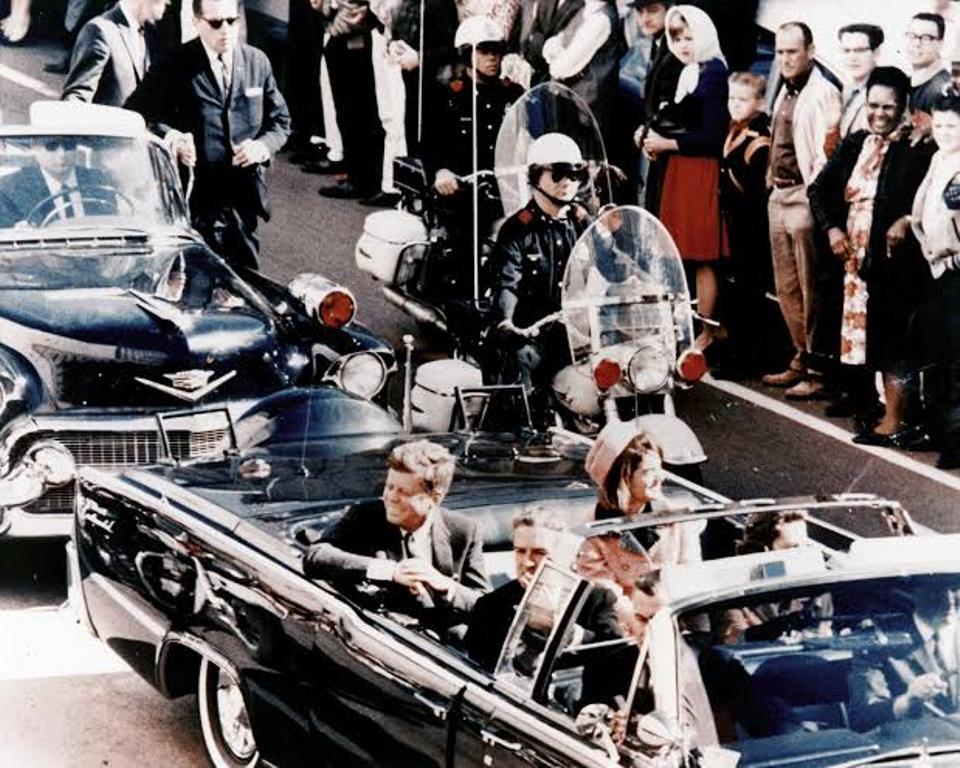
For many people the assassination of John F. Kennedy is a ‘flashbulb memory’ – a memory they can instantly recall where they were when the news broke of his death.
Kennedy rode in a motorcade in Dallas, Texas, when Lee Harvey Oswald sniped him from the School Book Depository, above the procession route.
Many conspiracy theories have ensued – that Oswald either did or didn’t act alone, that government agencies and foreign nations were involved, or that a second sniper existed on the infamous ‘grassy knoll.’
Whatever the case, Kennedy was a young, charismatic politician who had high approval ratings, and his death was mourned as a tragedy by many people in America and beyond.
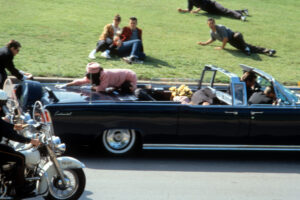
The Event
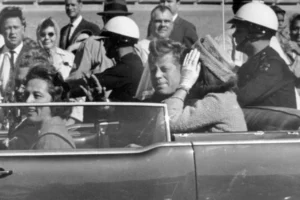
- The Shooting: Shots were fired from the sixth floor of the nearby Texas School Book Depository as the motorcade passed. President Kennedy was fatally wounded, and Texas Governor John Connally was also seriously injured.
- The Hospital: The motorcade rushed Kennedy to Parkland Memorial Hospital, where he was pronounced dead about 30 minutes later.
- The Succession: Vice President Lyndon B. Johnson was sworn in as the 36th U.S. President just over two hours later aboard Air Force One at Dallas Love Field.
The Suspect and Aftermath
- Lee Harvey Oswald: Former U.S. Marine Lee Harvey Oswald was arrested as the prime suspect. Two days later, on November 24, Oswald was fatally shot in the basement of Dallas police headquarters by local nightclub owner Jack Ruby during a live televised transfer.
- Investigations:
- The Warren Commission (1964) concluded that Oswald acted alone in assassinating Kennedy.
- The House Select Committee on Assassinations (1979) later concluded that Kennedy was likely killed as the result of a conspiracy, though it did not identify another specific gunman. [1]
- Declassification: Millions of pages of government files have been preserved and released through the National Archives under the President John F. Kennedy Assassination Records Collection Act, with additional rolling declassifications occurring in recent years.
A minute-by-minute breakdown of the tragic events in Dealey Plaza on November 22, 1963:
Video