
Few experiences rival the enchantment of December in Europe. From snow-dusted medieval squares aglow with fairy lights to the warm aroma of roasted chestnuts and spiced mulled wine drifting through cobblestone streets, the continent transforms into a living winter storybook. Whether you seek centuries-old traditions, alpine adventures, or glittering imperial capitals, spending Christmas in Europe offers unforgettable festive magic—and knowing where to go makes all the difference.
How to Experience Christmas Like a Local in Europe
Spending the holidays in Europe is about far more than sightseeing; it is an invitation to slow down and immerse yourself in centuries-old seasonal rituals. Across the continent, the festive season begins in late November with the start of Advent and stretches, in many regions, well into early January.
-
Wander the Advent Markets: At the heart of European holiday culture are the Christkindlmarkts and Marchés de Noël. Rather than rushed shopping trips, these open-air wooden villages are social gathering hubs. Visitors spend evenings strolling between stalls browsing hand-carved wooden ornaments, blown-glass baubles, and artisanal woolens while sipping hot Glühwein (mulled wine) or vin chaud from collectible ceramic mugs.
-
Savor Seasonal Gastronomy: Every region boasts distinct winter delicacies. In Central Europe, the air smells of sizzling Bratwurst, roasted almonds, and cinnamon-dusted chimney cakes (kürtőskalács or trdelník). In France and Belgium, holiday tables shine with bûche de Noël (Yule log cake), artisanal chocolates, and warm waffles, while Southern Europe celebrates with sweet panettone, roasted chestnuts, and lively midnight masses.
-
Embrace Winter Concerts and Ice Skating: Beyond the markets, Europe’s historic architecture becomes a stage for holiday culture. Grand cathedrals host candlelit classical concerts and choir performances, while city squares and palace courtyards install open-air ice rinks where skaters glide beneath illuminated facades.
The Most Popular European Cities for Christmas
While nearly every town dresses up for December, a handful of iconic destinations stand out for their atmosphere, scale, and holiday spirit.
1. Strasbourg, France — The “Capital of Christmas”
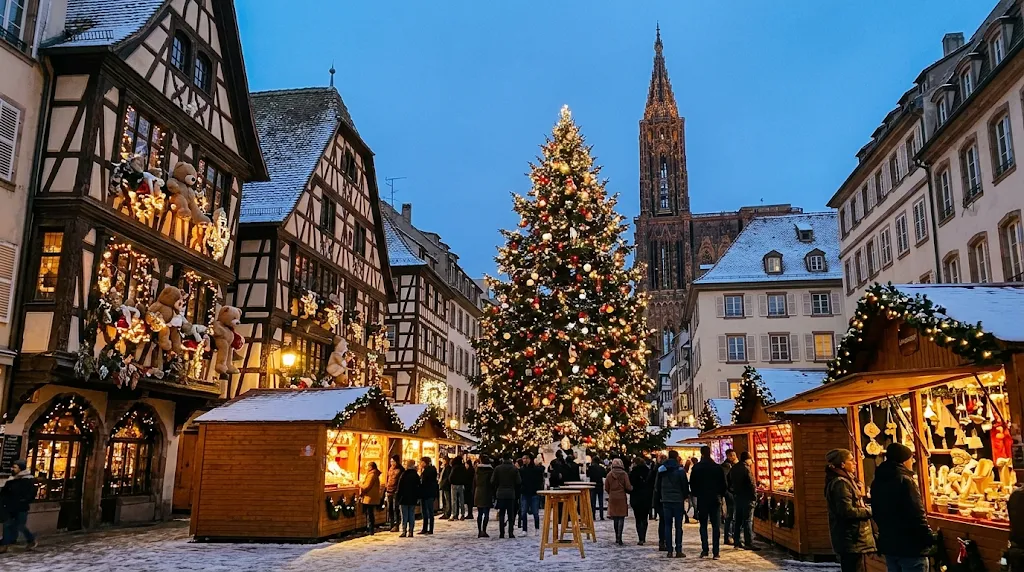
Nestled in the Alsace region near the German border, Strasbourg is home to the Christkindelsmärik, which dates back to 1570 and ranks among the oldest Christmas markets in Europe. Half-timbered houses are draped in oversized teddy bears, glowing stars, and evergreen garlands, while a towering Great Christmas Tree anchors Place Kléber. Travelers often pair Strasbourg with nearby Colmar, a canal-laced fairy-tale town whose intimate markets feel straight out of a picture book.
2. Vienna, Austria — Imperial Elegance and Classical Music
Few cities do grandeur quite like Vienna. During December, imperial palaces—including Schönbrunn and Belvedere—host refined markets selling traditional crafts and Austrian pastries. The flagship Wiener Christkindlmarkt on Rathausplatz features over a hundred stalls alongside a massive ice-skating trail winding through City Hall Park. Evening visitors can warm up inside gilded concert halls with performances of Mozart and Strauss, or linger over Sachertorte and hot chocolate in historic Viennese coffeehouses.
3. Prague, Czech Republic — A Gothic Fairytale
With its cobblestone lanes, astronomical clock, and Gothic spires, Prague looks enchanting year-round, but snow and holiday lights elevate it to pure magic. The Old Town Square market gathers beneath the twin towers of the Church of Our Lady before Týn, centered around a giant spruce tree and a traditional nativity scene. A major advantage for holiday travelers is timing: unlike many Western European markets that close on December 24, Prague’s stalls remain open through Christmas Day and into early January.
4. Nuremberg and Dresden, Germany — Birthplace of Market Traditions
Germany is the spiritual homeland of the Christmas market, and two cities lead the pack. Nuremberg’s Christkindlesmarkt is famous for strict rules ensuring only traditional, handmade goods are sold, alongside local Lebkuchen (spiced gingerbread) and miniature grilled sausages. Meanwhile, Dresden hosts the Striezelmarkt (first documented in 1434), celebrated for its giant wooden Christmas pyramid from the nearby Ore Mountains and Christstollen, a rich fruit bread dusted in powdered sugar.
5. Rovaniemi, Finland — An Arctic Winter Wonderland
For travelers dreaming of guaranteed snow, reindeer sleigh rides, and Northern Lights, Rovaniemi in Finnish Lapland is unmatched. Located right on the Arctic Circle, it is the official hometown of Santa Claus. Visitors can cross the Arctic Circle line at Santa Claus Village, send postcards with a special Arctic postmark, embark on husky safaris through silent pine forests, and unwind in traditional wood-fired Finnish saunas.
6. London, United Kingdom — Glittering Lights and Festive Theater
London blends British heritage with dazzling urban spectacle. Regent Street and Oxford Street sparkle beneath canopies of glowing angels and stars, while Covent Garden showcases massive mistletoe chandeliers and a giant decorated tree. Hyde Park transforms into Winter Wonderland, offering ice skating, circus shows, and Bavarian-style chalets, while the West End and Royal Albert Hall fill December evenings with classic pantomimes and carol concerts.
7. Budapest, Hungary — Thermal Baths and Riverfront Lights
Offering remarkable beauty and great value, Budapest shines along the Danube during Advent. The Advent Feast at St. Stephen’s Basilica features a 3D light show projected onto the church facade, craft stalls, and an ice rink. Best of all, visitors can pair chilly evenings outdoors with a soak in the steaming outdoor pools of the historic Széchenyi Thermal Bath.
Essential Tips for Planning Your European Christmas Trip
-
Watch the Calendar: Many markets in Germany, France, and Austria close at midday on December 24. If you plan to travel between Christmas and New Year, prioritize cities like Prague, Budapest, Zagreb, or London, where festivities run into January.
-
Pack for Cobblestones and Cold: Layered thermal clothing, waterproof insulated boots with good grip, and warm gloves are essential for standing outdoors in sub-zero evening temperatures.
-
Carry Cash for Stalls: While larger cities increasingly accept contactless cards, smaller artisan booths and mug-deposit stands often still prefer local cash.
Spending Christmas in Europe is a celebration of warmth in the depths of winter. Whether you are toasting with mulled wine beneath a Gothic cathedral in Germany, gliding across an ice rink in Vienna, or chasing the Northern Lights in Lapland, the continent’s timeless traditions turn the holiday season into an unforgettable journey. -Stories