

POV: It’s June 2009, I’m on summer vacation, and my mom just woke me up to tell me that Michael Jackson died. But lo and behold, on April 23rd, 2026, he was resurrected.
I cannot begin to convey how excited I was to see this movie. As a Gen Z sun, Millennial moon, and Gen X rising, my relationship to Michael has always been slightly parasocial, fragmented, and stitched together through grainy interviews on YouTube at 2am, my aunt’s old iPod, and family weddings where “Don’t Stop Til You Get Enough” turns into a full-body sport. Unfortunately, I was not there during his prime, but then again, it was Michael Jackson—his prime was his entire life. So, even though I was too young to be an MJ fanatic, I ended up one anyway. “Smooth Criminal” was one of my favorite songs, and I had a dance routine to “Remember the Time.” Watching Michael felt like finally hearing the original Michael Jackson sound (in IMAX)—loud enough to shake something loose and experience what it was like to be there in his heyday, first row.
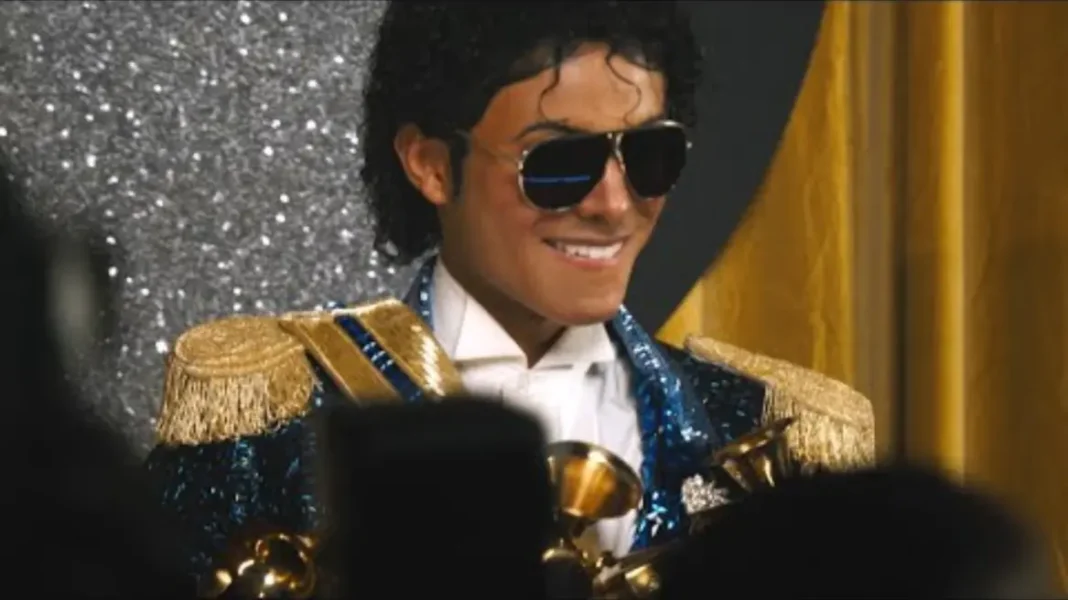
Let’s get one thing out of the way: Jaafar Jackson is not playing Michael Jackson: he is him. Not in a caricatured, overly studied way, but in a way that makes you forget that he is merely acting. His voice is scarily similar. His posture lands effortlessly. Even in his stillness Jaafar embodies Michael. And then, there are his performances. There’s a split second watching him where you’re hyper-aware that you are at the cinema—you are watching an actor and mentally preparing to critique him. Then, something clicks, almost uncomfortably fast. It’s in the shoulders first. The legs. The feet. Then, the hands. And finally, the eyes. Suddenly, you’re not analyzing anymore; you are watching Michael Jackson come back from the dead. I caught myself leaning forward, mouth agape, without realizing I was doing so—like my body clocked him before my brain did. Over the course of the film, it genuinely starts to feel like Jaafar isn’t disappearing into the role but like Michael is borrowing his skin for a couple of hours.

The performances don’t feel like movie scenes that are being reenacted; they feel more like full-blown concerts that I am attending. Full, true to source, stretched-out moments, where the film stops trying to impress you and just lets Ja-Michael do his thing. The Motown 25 sequence is one of the best on-screen performances I have ever witnessed. When Jaafar hit the moonwalk, there was a ripple through the audience—half gasp, half laugh, like we were all in on the same memory. And don’t get me started on “Human Nature”…. The minute I heard that first note, the tears started and did not stop. Jaafar captures Michael’s intensity and the gentleness in the song in a way that made me fall in love with it all over again. Both music videos for “Thriller”and “Beat It” were recreated almost flawlessly (the former being the most successful music video of all time), and it was magical to see them on the big screen.
The movie ends with MJ announcing the Jackson 5’s final tour in 1984 and transitions to the Bad Tour Live At Wembley 1989. In the final performance you could really see Jaafar in his element and play Michael better than anyone ever could have. It was more of a concert than it was a movie, and that’s exactly what made it perfect.

What I didn’t expect to walk away thinking about this much was Colman Domingo as Joe Jackson. There was nothing cartoonish about the way he plays him. He captures Joe in a way that is controlled, sharp, and definitely uncomfortable to sit with. You feel the authority and harshness immediately, and at the same time, there are flashes where you understand how much of Michael’s discipline, and even his perfectionism, came from such an abusive environment. The film massively tones down Joe’s abusive behavior—so you kind of get a glimpse into why Michael was the way he was.
To critique, I kept wishing the film would zoom out a bit more. It’s very focused on Michael’s immediate world, leaving out many significant moments. Diana Ross is essential to his story, not just as a figure but as part of the emotional and artistic landscape he came up in and yet was left out of. Similarly, with the recording for the music video of “We Are The World,” Lionel Richie, Stevie Wonder, Bruce Springsteen, Cyndi Lauper, and all of the powerhouses of the 80s come together to raise funds for Ethiopia. And then there’s The Wiz era, which I fully think should have been in the movie. That’s where he meets Quincy Jones, arguably one of the most important creative partnerships of his entire career. That collaboration shaped Off the Wall, Thriller, and everything that followed. Although we do meet Quincy Jones in the film, there isn’t enough of a backstory or introduction to him. I would have loved seeing the beginning of something that would go on to redefine pop music.
This review is not about whether Michael is a good biopic or whether they got it wrong or right. You realize that it’s much simpler than that. The film is a love letter. Not a perfect one, nor a complete one, and definitely not an objective one—but a love letter to Michael Jackson: as an artist, as a presence, and as someone people still can’t fully let go of. I know I can’t.

I still listen to Michael on a daily basis and maintain that he was a mighty force of a man. There is a reason he was, and still is, the King of Pop. His music, his songwriting, his dance moves, and just the sheer amount of grace he exuded have not been replicated until today. Maybe that’s why it works. Michael brought back all my happy memories from my childhood—especially one where I remember my grandmother buying me a Michael Jackson’s Greatest Hits cassette tape off the street in Roxy. Great film, greater man.
flair-magazine
Video